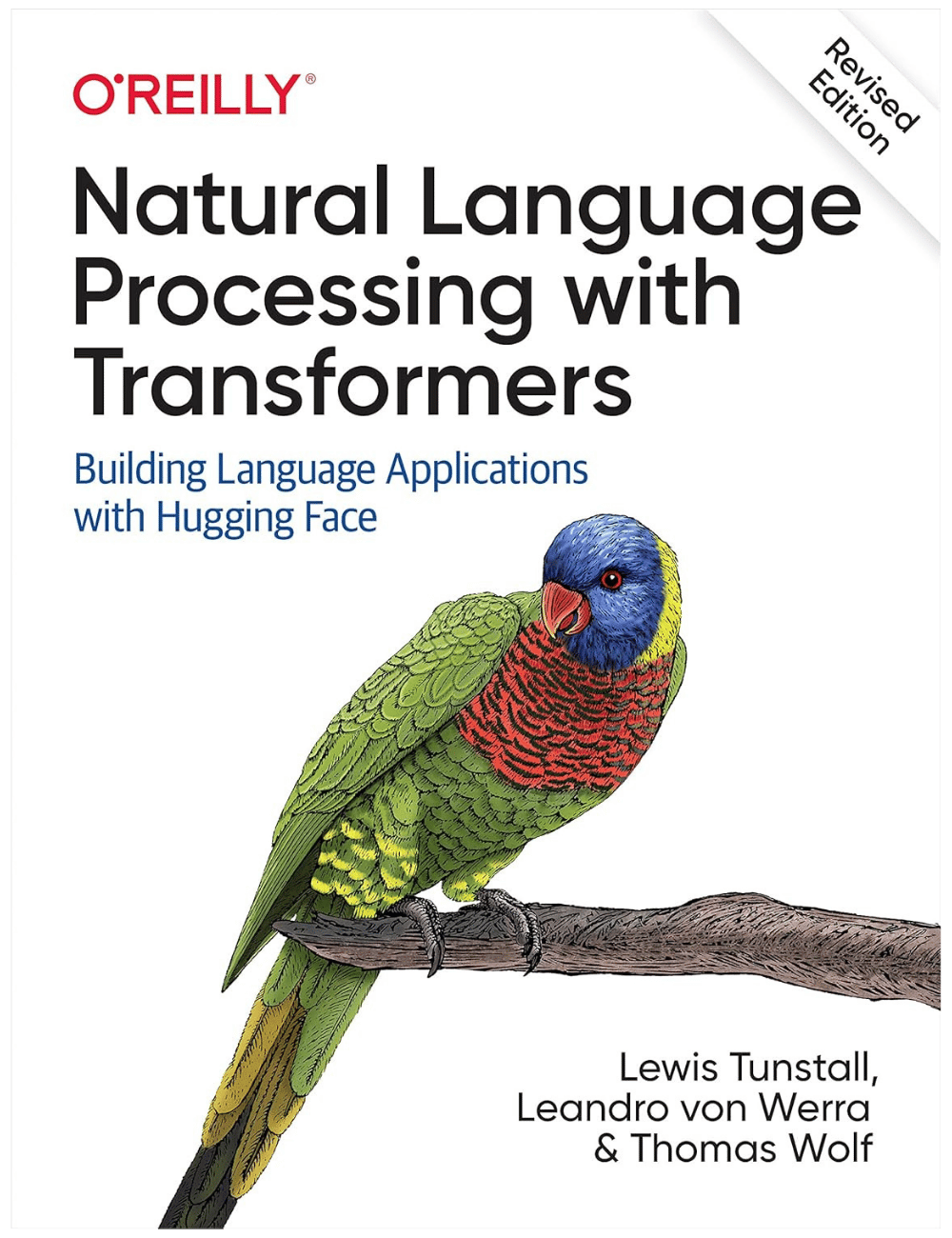
Availability: In Stock

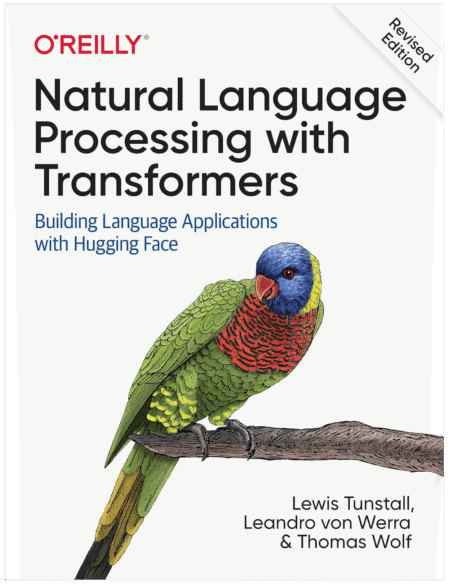
Natural Language Processing with Transformers, Revised Edition 1st Edition

Original price was: 320.00 Dhs.Current price is: 265.00 Dhs.

Since their introduction in 2017, transformers have quickly become the dominant architecture for achieving state-of-the-art results on a variety of natural language processing tasks. If you’re a data scientist or coder, this practical book -now revised in full color- shows you how to train and scale these large models using Hugging Face Transformers, a Python-based deep learning libra….

Description

Since their introduction in 2017, transformers have quickly become the dominant architecture for achieving state-of-the-art results on a variety of natural language processing tasks. If you’re a data scientist or coder, this practical book -now revised in full color- shows you how to train and scale these large models using Hugging Face Transformers, a Python-based deep learning library.

Transformers have been used to write realistic news stories, improve Google Search queries, and even create chatbots that tell corny jokes. In this guide, authors Lewis Tunstall, Leandro von Werra, and Thomas Wolf, among the creators of Hugging Face Transformers, use a hands-on approach to teach you how transformers work and how to integrate them in your applications. You’ll quickly learn a variety of tasks they can help you solve.

  • Build, debug, and optimize transformer models for core NLP tasks, such as text classification, named entity recognition, and question answering
  • Learn how transformers can be used for cross-lingual transfer learning
  • Apply transformers in real-world scenarios where labeled data is scarce
  • Make transformer models efficient for deployment using techniques such as distillation, pruning, and quantization
  • Train transformers from scratch and learn how to scale to multiple GPUs and distributed environments

From the Preface

Who Is This Book For?

This book is written for data scientists and machine learning engineers who may have heard about the recent breakthroughs involving transformers, but are lacking an in-depth guide to help them adapt these models to their own use cases. The book is not meant to be an introduction to machine learning, and we assume you are comfortable programming in Python and has a basic understanding of deep learning frameworks like PyTorch and TensorFlow. We also assume you have some practical experience with training models on GPUs. Although the book focuses on the PyTorch API of Transformers, Chapter 2 shows you how to translate all the examples to TensorFlow.

What You Will Learn

The goal of this book is to enable you to build your own language applications. To that end, it focuses on practical use cases, and delves into theory only where necessary. The style of the book is hands-on, and we highly recommend you experiment by running the code examples yourself.

The book covers all the major applications of transformers in NLP by having each chapter (with a few exceptions) dedicated to one task, combined with a realistic use case and dataset. Each chapter also introduces some additional concepts. Here’s a high-level overview of the tasks and topics we’ll cover:

– Chapter 1, Hello Transformers, introduces transformers and puts them into context. It also provides an introduction to the Hugging Face ecosystem.

– Chapter 2, Text Classification, focuses on the task of sentiment analysis (a common text classification problem) and introduces the Trainer API.

– Chapter 3, Transformer Anatomy, dives into the Transformer architecture in more depth, to prepare you for the chapters that follow.

– Chapter 4, Multilingual Named Entity Recognition, focuses on the task of identifying entities in texts in multiple languages (a token classification problem).

– Chapter 5, Text Generation, explores the ability of transformer models to generate text, and introduces decoding strategies and metrics.

– Chapter 6, Summarization, digs into the complex sequence-to-sequence task of text summarization and explores the metrics used for this task.

– Chapter 7, Question Answering, focuses on building a review-based question answering system and introduces retrieval with Haystack.

– Chapter 8, Making Transformers Efficient in Production, focuses on model performance. We’ll look at the task of intent detection (a type of sequence classification problem) and explore techniques such a knowledge distillation, quantization, and pruning.

– Chapter 9, Dealing with Few to No Labels, looks at ways to improve model performance in the absence of large amounts of labeled data. We’ll build a GitHub issues tagger and explore techniques such as zero-shot classification and data augmentation.

– Chapter 10, Training Transformers from Scratch, shows you how to build and train a model for autocompleting Python source code from scratch. We’ll look at dataset streaming and large-scale training, and build our own tokenizer.

– Chapter 11, Future Directions, explores the challenges transformers face and some of the exciting new directions that research in this area is going into.


Book details
  • Author : Lewis Tunstall, Leandro von Werra, Thomas Wolf,
  • Publisher ‏: O’Reilly Media
  • Publication date ‏: ‎July 5, 2022
  • Edition ‏: ‎ 1st
  • Print length : 406 pages
  • Language : English
  • Format : Paperback

Additional information

book-author

, ,

Select Format

Paperback